We offer a significant improvement in the operational quality of your power transformers by installing technical condition monitoring systems as well as explosion and fire protection systems.
Installation of SERGI and Monitoring Systems
Explosion and Fire Protection System
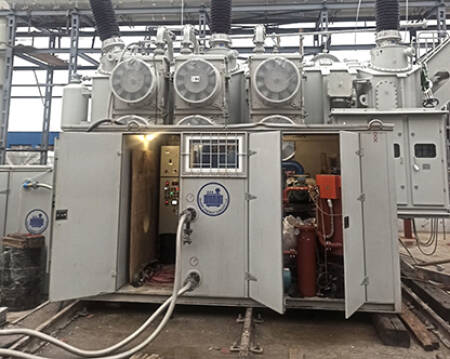
 SERGI Transformer Protector System for Preventing Explosions and Fires in Oil-Filled Transformers
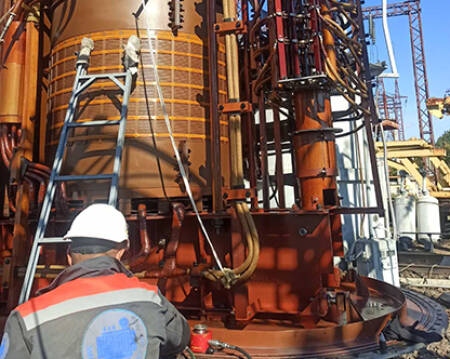
The SERGI TP system provides pressure relief in the event of short circuits in transformers within a few milliseconds, allowing explosions and subsequent fires to be avoided.
The rapid response and functionality of the SERGI system make it the only effective solution for protecting transformers against explosions.
Manufacturer: Sergi Transformer Protector (France)
Technical Characteristics:
- Response time of the protection system to prevent explosions in the event of a short circuit: 0.5 to 20 ms;
- Safe venting of combustible gases from the transformer;
- Removal of explosive gases through nitrogen injection into the transformer tank;
- Suitable for installation on both new and in-service transformers with ratings from 0.1 MVA to 1000 MVA and above.
Traditional transformer protection systems are insufficient in the case of an arc short circuit in an oil-filled transformer, because the pressure rises to the point of tank rupture in less than 100 milliseconds, which is significantly faster than the response time of conventional protection devices and circuit breakers.
SERGI Transformer Protector System:
- Prevents damage and fire in transformers;
- Protects nearby equipment;
- Allows rapid and safe repair of transformers after internal faults;
- Prevents environmental contamination;
- Eliminates risks to human life.
Transformer Condition Monitoring System
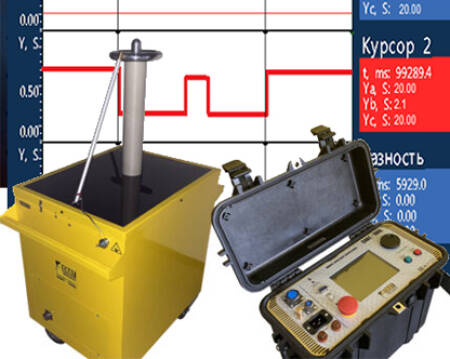
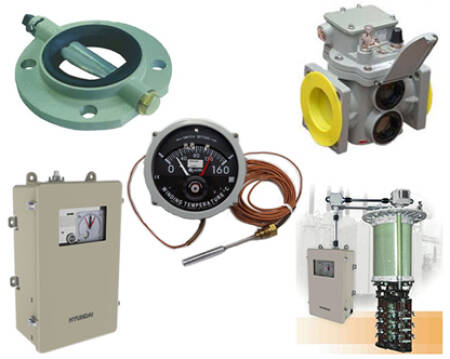
The Transformer Condition Monitoring System is designed for continuous monitoring and analysis of the technical condition of high-voltage power transformers. It is used for real-time registration and data collection, allowing the analysis of key transformer subsystem parameters and generating a comprehensive assessment of the transformer’s condition.
The system addresses the following objectives:
- Increases the likelihood of timely detection of equipment defects;
- Detects a range of defects that are not accessible through periodic inspections;
- Provides monitoring without taking equipment out of service;
- Automates the processing and evaluation of diagnostic information by operational personnel;
- Facilitates a transition from outdated periodic maintenance methods to condition-based maintenance;
- Reduces the influence of human factors on the operation of power systems;
- Enables automated generation of diagnostic data for strategic planning of maintenance and equipment replacement.
Monitored Parameters
Transformers:
- Temporary overvoltage events;
- Oil and winding temperatures;
- Gas and moisture content in oil;
- Condition, efficiency, and lifespan of the cooling system;
- Load capacity;
- Short-circuit impedance;
- Operating voltages, currents, and power;
- Oscillograms;
- Power quality indicators;
- Impulse voltages;
- Residual insulation life of windings;
- Cooling system management;
- Oil temperature in the OLTC (On-Load Tap Changer) contactor;
- OLTC drive power (current);
- Mechanical and electrical life of the OLTC contactor;
- Duration of OLTC switching operations;
- Current oscillograms during OLTC switching;
- Operation time at each OLTC tap position;
- Manual and remote control of the OLTC.
Bushings:
- Dielectric loss tangent of the main insulation (tgδ₁) and its variation;
- Capacitance of the main insulation (C₁) and its variation;
- Three-phase insulation leakage current imbalance;
- Dynamics of tgδ₁ variation;
- Temperature dependence of tgδ₁;
- Partial discharge characteristics.
Current Transformers:
- Dielectric loss tangent of the main insulation (tgδ₁) and its variation;
- Capacitance of the main insulation (C₁) and its variation;
- Three-phase insulation leakage current imbalance;
- Partial discharge characteristics;
- SF₆ gas density (for gas-insulated transformers);
- Residual lifespan forecast.
Non-Linear Surge Arresters (NSAs):
- Complex conduction current and its spectral composition;
- Surface contamination level;
- Number and characteristics of discharge currents.